
Best EV Wiring Harness Manufacturing Services in India
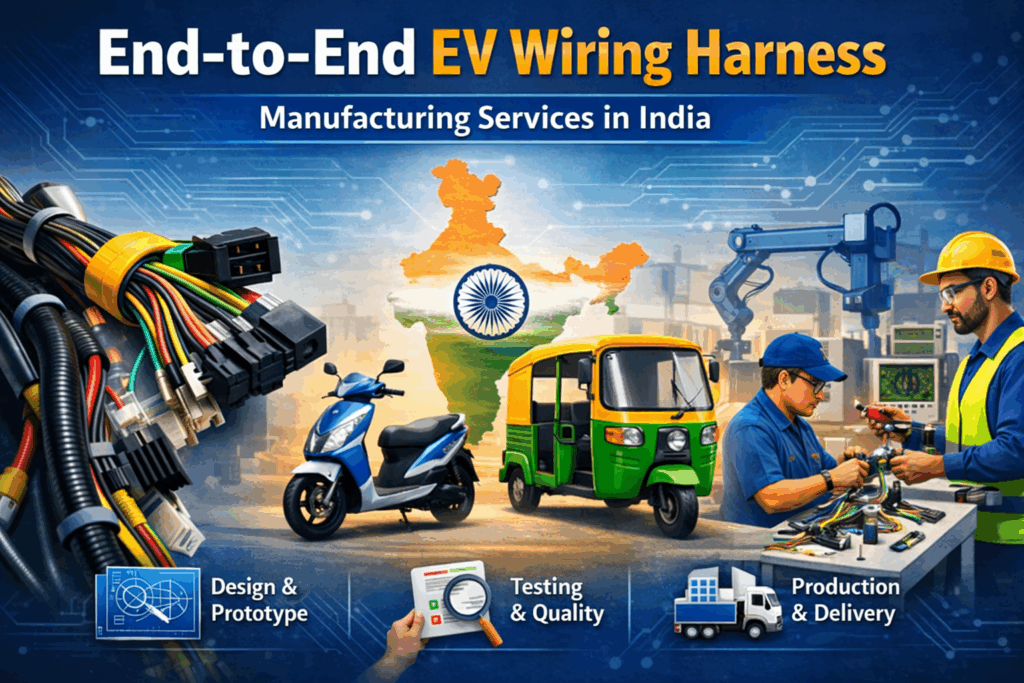
End-to-End EV Wiring Harness Manufacturing Services in India – Complete Guide for OEMs & Startups
India is going through a major shift in the automotive industry. Electric vehicles (EVs) are no longer just a future idea—they are becoming a part of daily life. From electric scooters used for commuting to e-rickshaws used for business, EV adoption is increasing rapidly across the country.
Behind every successful EV, there is a strong and reliable electrical system. One of the most important parts of this system is the wiring harness. It connects all electrical components and ensures smooth communication and power flow across the vehicle.
Many EV manufacturers and startups face challenges when working with multiple vendors for different stages like design, testing, and production. This often leads to delays, miscommunication, and quality issues.
To solve this problem, many companies now prefer end-to-end EV wiring harness manufacturing services in India. This approach offers a complete solution under one roof, making the process faster, more efficient, and more reliable.
In this detailed guide, we will explain everything you need to know about EV wiring harness manufacturing in simple and easy-to-understand language.
What is an EV Wiring Harness?
An EV wiring harness is a structured set of wires, connectors, terminals, and protective materials used to connect all electrical and electronic components in an electric vehicle.
You can think of it as the “nervous system” of the vehicle. Just like nerves carry signals in the human body, a wiring harness carries electrical signals and power between different parts of the vehicle.
Key Functions of a Wiring Harness:
- Distributes power from the battery to different components
- Connects motor, controller, and charging system
- Supports lighting, indicators, and dashboard
- Enables communication between electronic parts
Without a proper wiring harness, even the most advanced EV cannot function properly.
What Does End-to-End Manufacturing Mean?
End-to-end manufacturing means that one company handles the entire process of wiring harness production—from the initial concept to final delivery.
This includes:
1. Requirement Understanding
The manufacturer studies your vehicle design and understands your specific needs.
2. Design & Engineering
Engineers create a detailed wiring layout based on the vehicle structure.
3. Material Selection
High-quality wires, connectors, and insulation materials are selected.
4. Prototyping
A sample harness is developed for testing and validation.
5. Testing & Quality Check
The prototype is tested for safety, performance, and durability.
6. Mass Production
After approval, large-scale production begins.
7. Final Inspection & Delivery
Each unit is checked before delivery to ensure quality.
This complete process under one roof reduces errors and improves efficiency.
Why End-to-End Services Are Important in the EV Industry
The EV industry is highly competitive and fast-growing. Companies need to launch products quickly without compromising quality.
Here’s why end-to-end services are important:
1. Improved Quality Control
When one company handles everything, it becomes easier to maintain consistent quality.
2. Faster Product Development
No need to coordinate between multiple vendors. This saves a lot of time.
3. Cost Efficiency
Reduces hidden costs such as delays, rework, and transportation between vendors.
4. Better Communication
You have a single point of contact, making coordination easier.
5. Custom Solutions
Each EV model has different requirements, and end-to-end services allow flexibility.
This approach is especially useful for EV startups and OEMs.
Wiring Harness in Electric Two-Wheelers (Scooters & Bikes)
Electric two-wheelers are the most popular EV segment in India. They are widely used for daily commuting due to their affordability and convenience.
Role of Wiring Harness in Two-Wheelers:
- Connects battery to motor
- Controls lights and indicators
- Supports digital display and sensors
- Manages charging system
Challenges in Two-Wheeler Harness Design:
- Limited space inside the vehicle
- Need for lightweight components
- Heat management near battery and motor
How End-to-End Services Help:
- Compact and efficient harness design
- Better wire routing for space optimization
- Use of lightweight and durable materials
This improves overall vehicle performance and user experience.
Wiring Harness in Electric Three-Wheelers (E-Rickshaws)
Three-wheelers are commonly used for passenger transport and goods delivery. These vehicles operate for long hours and require strong electrical systems.
Role of Wiring Harness:
- Supplies power to motor and controller
- Connects battery system
- Supports lighting and safety systems
- Enables charging functionality
Challenges:
- Heavy usage leading to wear and tear
- Exposure to dust, heat, and moisture
- Need for long-lasting performance
Benefits of End-to-End Manufacturing:
- Strong and durable harness design
- Better protection against environmental conditions
- Reduced maintenance and downtime
For commercial vehicles, reliability directly affects business income.
Key Components of EV Wiring Harness
A wiring harness is made up of several important components:
1. Wires and Cables
Carry electrical current across the system
2. Connectors
Join different electrical components
3. Terminals
Provide secure electrical contact
4. Protective Sleeves
Protect wires from heat, vibration, and damage
5. Clamps and Fasteners
Keep the harness organized and fixed in place
Each component must be carefully selected to ensure safety and durability.
Detailed EV Wiring Harness Design Process
Designing a wiring harness requires technical expertise and planning.
Step 1: Requirement Analysis
Understanding the vehicle type, voltage levels, and electrical load
Step 2: Layout Design
Planning the routing of wires to avoid interference and damage
Step 3: Material Selection
Choosing materials that can handle heat, voltage, and environmental conditions
Step 4: Prototyping
Developing a sample harness for testing
Step 5: Testing
Ensuring performance, safety, and durability
Step 6: Production
Manufacturing in bulk with strict quality control
A well-designed harness improves efficiency and reduces failures.
Testing & Quality Standards
Testing is critical to ensure safety and performance.
Common Tests:
- Electrical continuity test
- Voltage resistance test
- Thermal testing
- Vibration testing
- Waterproof testing
Standards:
- ISO certification
- Automotive industry standards
Proper testing ensures long life and safe operation.
Manufacturing Capabilities to Look For
A good manufacturer should have:
- Advanced production machinery
- Skilled workforce
- In-house testing labs
- Quality control systems
- Ability to handle bulk orders
These capabilities ensure consistent quality and timely delivery.
Why Choose India for EV Wiring Harness Manufacturing
India is emerging as a global manufacturing hub.
- Advanced production machinery
- Skilled workforce
- In-house testing labs
- Quality control systems
- Ability to handle bulk orders
Key Advantages:
- Cost-effective production
- Skilled labor and engineers
- Strong supply chain
- Government support for EV industry
- Export opportunities
Cities like Pune are known for their strong automotive ecosystem.